Why I Am Not Optimistic About the Carney Era
A deeper look at why the job market feels increasingly strained
Canada’s job market feels increasingly difficult, even as official narratives remain cautiously optimistic. This article explores the structural reasons behind rising unemployment, slowing growth, and weakening opportunity — and why the current trajectory under the Carney era may not be as promising as it seems.

My skepticism toward the Carney era is not rooted in a dismissal of Mark Carney himself, nor in a failure to recognize his strengths. On the contrary, Carney represents what many would consider an ideal modern economic leader: technically competent, globally respected, articulate, and capable of translating complex economic realities into coherent narratives. Precisely because he embodies these strengths, however, I find it necessary to ask a more uncomfortable question: what if the strongest asset of this era is not actual economic improvement, but the credibility of its messaging? Carney assumed office as Prime Minister in March 2025, which means the “Carney era” is still in its early stages. Many of the negative indicators we observe today cannot be fairly attributed to his administration alone. Yet this is exactly why a forward-looking evaluation matters more than backward-looking blame. The question is not whether he caused the current conditions, but whether the conditions suggest a trajectory worth optimism.

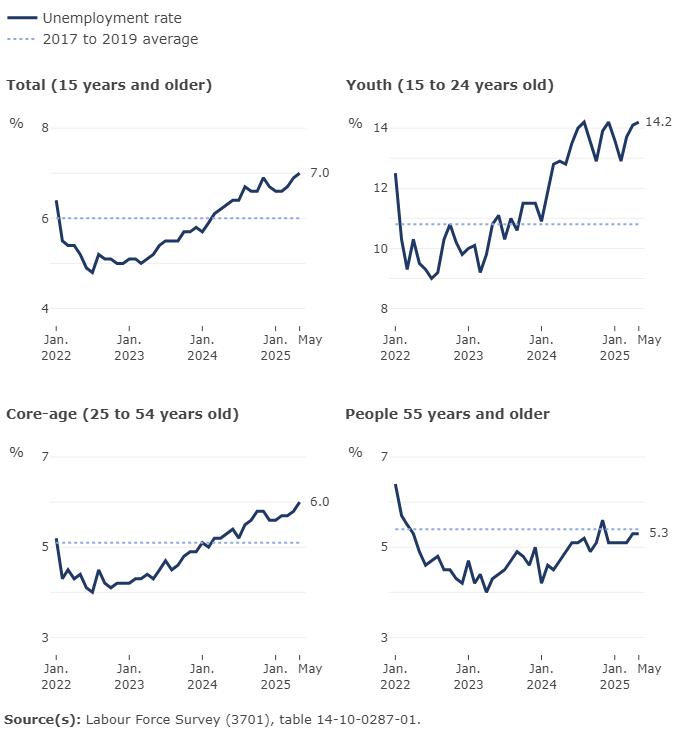
The first reason for concern lies in the growing gap between perception and measurable outcomes. Canada today does not exhibit the characteristics of an economy that has clearly entered a strong recovery phase. According to Statistics Canada’s Labour Force Survey, the national unemployment rate stood at 6.7% in March 2026, with employment essentially flat. In Ontario, the unemployment rate reached 7.6%, and official commentary noted that labor market conditions in southern Ontario remained “challenging,” partly due to ongoing uncertainty related to U.S. tariffs. More strikingly, youth unemployment (ages 15–24) rose to 13.8%, compared to an average of 10.8% between 2017 and 2019. This is not simply a matter of perception or anxiety among young workers; it reflects a measurable deterioration in entry-level opportunities. When the baseline access point into the labor market weakens, it becomes difficult to sustain confidence in the broader system, regardless of how effectively that system is communicated.
The second issue is structural rather than cyclical. Canada’s economic challenges are not primarily the result of insufficient policy articulation; they stem from longstanding weaknesses in productivity, investment efficiency, and per capita growth. Statistics Canada reported that real GDP grew by 1.7% in 2025, yet in the fourth quarter GDP contracted by 0.2% on a quarter-over-quarter basis, and real GDP per capita was essentially flat. The OECD has consistently pointed out that Canada’s per capita growth lags behind peers, particularly the United States, and that population-driven expansion has not been matched by productivity-enhancing investment. In other words, aggregate growth figures may remain positive, but they increasingly fail to translate into improved living standards. When economic expansion depends more on population growth than on productivity gains, the result is a form of statistical growth that does not meaningfully improve individual outcomes.

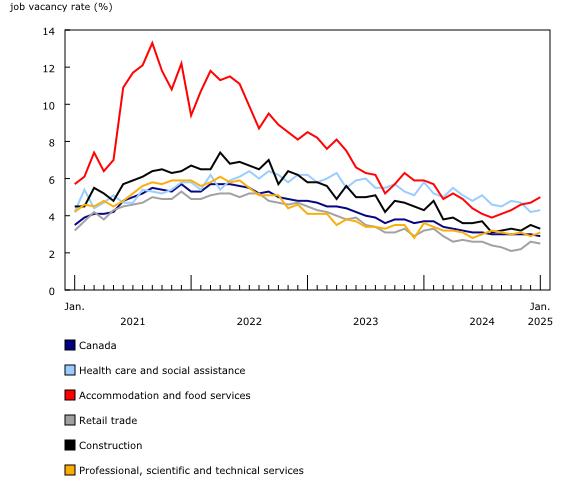
A third concern is the evolving nature of the labor market itself. The difficulties reported by job seekers—high application volumes, limited interview responses, increasing reliance on commission-based roles—are not isolated anecdotes but align with broader trends. Statistics Canada data on job vacancies indicates that in the fourth quarter of 2025, vacancy rates declined in 34 out of 41 economic regions, with only 7 showing increases. This suggests not a complete absence of jobs, but a contraction in accessible, stable, and high-quality positions. The labor market is not disappearing; it is fragmenting. For policymakers, the challenge is not simply to create jobs, but to ensure that those jobs are viable entry points into long-term economic participation. At present, there is limited evidence that such a transition is underway.

The fourth issue is Canada’s persistent productivity problem, which remains unresolved. While Statistics Canada reported some improvement in labor productivity in 2025—driven by GDP growth outpacing hours worked—the broader trend remains weak. The OECD continues to identify productivity growth as one of Canada’s most pressing structural challenges, emphasizing the need for more efficient capital allocation, stronger competition, and reduced interprovincial barriers. The existence of policy recognition does not imply policy success. A system that clearly understands its weaknesses but fails to produce sustained improvements cannot yet be described as being on a stable upward trajectory.

Housing presents a fifth area of concern. While there are signs of incremental progress—Canada Mortgage and Housing Corporation (CMHC) reported 259,028 housing starts in 2025, a 5.6% increase from the previous year—the scale of the problem remains far larger. CMHC has also indicated that annual housing starts would need to roughly double to close the supply gap by 2035. This means that current improvements, while positive, are insufficient to materially change affordability dynamics in the near term. Housing affordability is not an isolated issue; it directly affects labor mobility, career risk-taking, and entrepreneurial activity. As long as housing costs constrain personal decision-making, broader economic dynamism remains limited.

Fiscal policy adds another layer of uncertainty. Budget 2025 outlines a plan that combines disciplined operating spending with large-scale investment commitments, projecting deficits of $78 billion in 2025–26 and declining gradually in subsequent years. However, the Parliamentary Budget Officer (PBO) has raised concerns that average annual deficits could reach $64.3 billion over the medium term—significantly higher than earlier projections—and has questioned the likelihood that the government’s fiscal anchor will be maintained. The PBO also noted that the government’s definition of “capital investment” may overstate productivity-enhancing spending. The issue here is not the existence of deficits per se, but the risk that fiscal expansion may be used to sustain short-term stability without delivering long-term structural gains.

External conditions further complicate the outlook. Canada’s economic dependence on the United States remains significant, and recent developments—particularly trade tensions and tariff uncertainties—introduce constraints that domestic policy alone cannot easily offset. The Bank of Canada’s January 2026 Monetary Policy Report highlighted the impact of U.S. trade policy on Canadian growth, projecting average annual growth of approximately 1.25% and emphasizing elevated uncertainty. Statistics Canada also reported that exports declined by 1.7% in 2025, reflecting incomplete recovery from earlier disruptions. In such an environment, even well-designed domestic policies may struggle to generate strong outcomes.

To be clear, the Carney era is not without strengths. Inflation has remained relatively stable, with the Consumer Price Index rising 1.8% year-over-year in February 2026. The Bank of Canada has held its policy rate at 2.25%, suggesting that macroeconomic conditions are not deteriorating sharply. However, stability should not be mistaken for progress. A combination of low inflation, modest growth, weak productivity, and constrained opportunity can result in a form of stagnation that is less visible but equally consequential.

Ultimately, my skepticism is not about Carney as an individual, but about the structural constraints defining this period. Productivity weakness, lagging per capita growth, labor market fragmentation, housing constraints, fiscal uncertainty, and external dependency are not problems that can be resolved quickly, even under competent leadership. Carney may succeed in restoring confidence at the level of narrative and institutional credibility, but confidence that precedes results is inherently fragile. A truly optimistic era would be one in which improvements are not only articulated but consistently observable across employment, income growth, housing affordability, and investment behavior. At present, there is insufficient evidence to conclude that such a transition has begun.